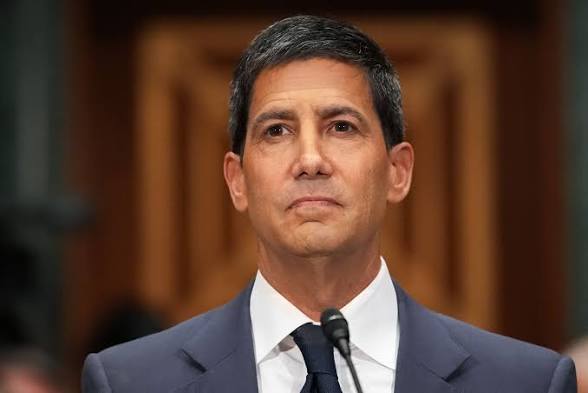
The key takeaway for Bitcoin is not about interest rate cuts but about Kevin Warsh’s plan to reduce the Federal Reserve’s balance sheet and drain liquidity from the financial system.
Warsh Faces the Senate and Outlines His Approach
On Tuesday, Kevin Warsh, selected by Donald Trump to succeed Jerome Powell as Federal Reserve Chair, appeared before the Senate Banking Committee. He emphasized that he would operate independently from the White House. However, he stopped short of committing to immediate rate cuts, leaving investors uncertain about how his leadership might affect liquidity and risk assets such as Bitcoin.
Focus Shifts From Interest Rates to Balance Sheet Reduction
The hearing produced several notable moments. Warsh stated that the Federal Reserve has lost direction and requires deep structural reform. Under oath, he claimed that Trump had never asked him to guarantee rate cuts at any particular meeting. This contradicted Trump’s earlier remarks to CNBC, where he said he would be disappointed if rate cuts did not happen immediately.
Senator Ruben Gallego challenged this inconsistency directly, suggesting that either Warsh or Trump was not telling the truth. Senator John Kennedy also pressed Warsh on whether he would act independently, to which Warsh firmly responded that he would not serve as anyone’s puppet and would act independently if confirmed.
On cryptocurrency, Warsh acknowledged that it is now integrated into the US financial system and stated that he would not support the creation of a central bank digital currency.
Quantitative Tightening Emerges as the Real Signal
While much attention focused on interest rates, analysts at XWIN Research Japan highlighted a more significant theme. Warsh’s remarks pointed toward balance sheet reduction, also known as quantitative tightening. This approach reduces the Federal Reserve’s bond holdings and removes liquidity from the system.
Unlike rate adjustments that influence the cost of money, this policy directly affects the amount of liquidity available. Analysts warned of a challenging scenario where short term rates decline while long term yields rise, a combination that has historically put pressure on risk assets.
Warsh reinforced this perspective by stating that the Federal Reserve’s balance sheet is too large and should be reduced. He also argued that the central bank should not hold long term Treasury securities. Additionally, he expressed opposition to the practice of signaling future rate decisions in advance, noting that it can lock policymakers into outdated expectations.
Bitcoin Market Reaction and On Chain Trends
Bitcoin initially reacted with volatility during the hearing, falling below seventy five thousand dollars before recovering to around seventy eight thousand dollars. At the time of writing, it showed gains of roughly 2.7 percent over the past day and 5.4 percent over the week.
Despite this price movement, XWIN Research pointed to underlying on chain data that suggests a different narrative. The Long Term Holder SOPR metric is currently near 1.0, indicating that holders are not aggressively selling at a profit.
Historically, this level reflects lower selling pressure and limited supply growth. In simple terms, even as macroeconomic conditions tighten, the available supply of Bitcoin is not increasing significantly.
Diverging Signals Suggest Accumulation Phase
The overall picture shows weakening macro liquidity alongside stable internal Bitcoin metrics. According to XWIN Research, this divergence may indicate an accumulation phase rather than a market breakdown. If liquidity conditions improve and demand from exchange traded funds returns, Bitcoin could be positioned for a strong upward move.#crypto#cryptonews https://coinsignals.net https://t.me/coinsignalpublic