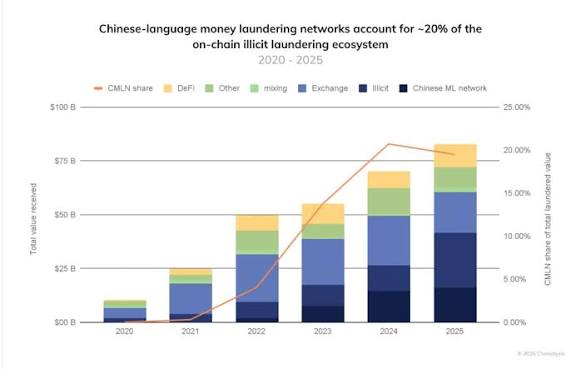
Chinese-language laundering networks now account for roughly 20% of known illicit crypto activity, according to Chainalysis. The broader on-chain money laundering ecosystem has expanded from $10 billion in 2020 to over $82 billion in 2025, driven by growing crypto accessibility and changes in laundering methods.
Chainalysis data shows these networks, often operating via Telegram, consistently launder more than 10% of funds stolen through “pig butchering” scams. Use of centralized exchanges has declined, while inflows to Chinese-language networks have surged far faster than other endpoints—over 7,000 times faster than exchanges, nearly 2,000 times faster than DeFi, and more than 2,000 times faster than intra-illicit transfers.
The ecosystem now includes six distinct service types that collectively processed $16.1 billion in 2025, with active wallets increasing to 1,799. Transaction patterns mimic traditional money laundering methods, including smurfing and aggregation.
Other networks are also evolving. In December 2024, UK authorities dismantled a multi-billion-dollar Russian-language laundering network serving cybercriminals, drug gangs, and elites. Experts note that limited enforcement capabilities make crypto a low-risk, high-reward tool for criminals worldwide.