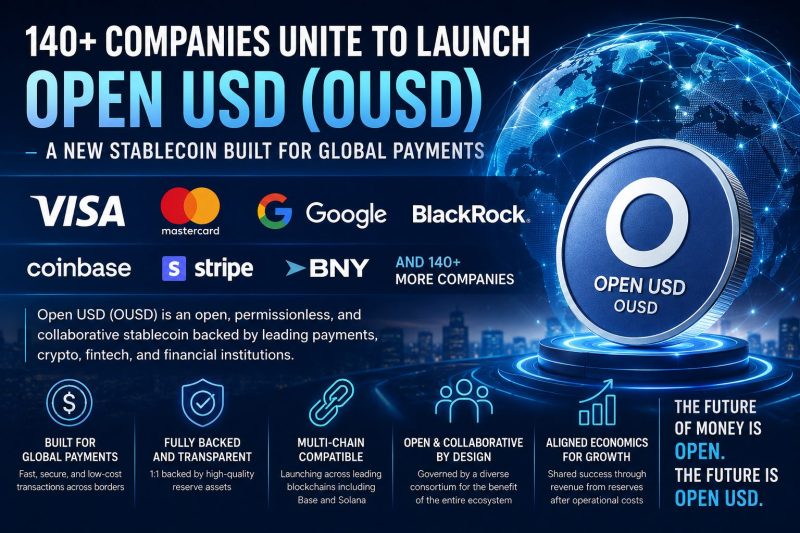
OpenUSD (OUSD) has quickly become one of the most talked about topics in the crypto market following the announcement of a consortium backed stablecoin supported by more than 140 companies.
Developed by Open Standard, the stablecoin is expected to launch later this year. Its promise of zero fee minting, shared reserve earnings, and collaborative governance has sparked strong interest across both financial and crypto sectors.
Growing Excitement Around OpenUSD
According to recent findings from Santiment, participation from major financial institutions and crypto firms has driven intense market discussion. OpenUSD has become one of the most widely discussed developments in crypto, alongside conversations around The Black Bull whale activity and Markets in Crypto-Assets licensing.
Market participants are actively debating key issues such as custody, transparency, liquidity, and whether another large stablecoin can realistically challenge dominant players like USD Coin and Tether.
The growing attention follows the official launch announcement from Open Standard, the independent body overseeing OpenUSD.
According to the project’s official announcement, OUSD is designed to improve global money movement while solving several common problems businesses face when using traditional stablecoins.
Although stablecoins have become increasingly valuable because they enable faster, cheaper, and programmable digital payments, many businesses still face challenges such as high minting and redemption costs, limited access to reserve generated revenue, and reliance on centralized issuers for product development.
Core Features of OpenUSD
OpenUSD is built around three key principles.
First, businesses can mint and redeem OUSD without fees or volume limits.
Second, participating partners will share earnings generated from reserve assets after operational costs and management fees are deducted.
Third, governance will be managed collectively through Open Standard, with partner organizations participating in decision making rather than leaving control to a single issuer.
This governance structure is intended to align decision making with the broader interests of the ecosystem.
Open Standard confirmed that more than 140 businesses have already committed to supporting or using OpenUSD. The list includes major firms such as Visa, Stripe, Mastercard, American Express, Coinbase, BlackRock, BNY, Standard Chartered, Intercontinental Exchange, Bybit, Solana, Base, OKX, and Ripple.
Samara Cohen, Global Head of Market Development at BlackRock, said stablecoins could play a major role in the future of digital markets when supported by reliable infrastructure and practical use cases. She described OpenUSD as an important step toward expanding access to tokenized value and internet native payment systems.
Could OpenUSD Pressure Circle?
The announcement of OpenUSD appears to have affected sentiment around Circle, the issuer of USD Coin.
On Tuesday, Circle’s stock, CRCL, fell 17.55 percent and closed at $62.63.
Sam Ruskin, a former research analyst at Messari, noted that OpenUSD’s structure could create real competitive pressure for Circle.
He suggested the new stablecoin model may force Circle to expand revenue sharing, strengthen distribution partnerships, or diversify its broader stablecoin strategy.#crypto#cryptonews https://coinsignals.net https://t.me/coinsignalpublic