Bitwise CIO Says Crypto Faces Three Year Trial if Clarity Act Stalls

The future of US crypto regulation remains uncertain as the Clarity Act, approved by the House in July 2025, is still under review in the Senate as of January 2026. Senate committees continue to debate market structure issues and investor protections, with key differences from the House version yet to be resolved.

Bitwise Chief Investment Officer Matt Hougan warned that if the Clarity Act fails to pass, the crypto industry would enter a critical testing phase lasting roughly three years. During this period, the sector would need to prove its real world value to everyday users and to the traditional financial system without relying on supportive regulation.

Hougan said that without legislation, today’s favorable regulatory tone would not be locked into law and could be reversed by a future administration. As a result, market growth would depend less on expectations and more on clear adoption of use cases such as stablecoins, tokenized assets, and blockchain based financial infrastructure.

He compared this path to companies like Uber and Airbnb, which initially operated in legal gray areas but became too widely used to ignore. Hougan cautioned, however, that crypto may not be guaranteed the same outcome. If adoption remains limited, political shifts could create major headwinds and keep investors cautious.

By contrast, Hougan said passing the Clarity Act in an industry friendly form could trigger a strong rally, as markets would view crypto growth as structurally supported rather than speculative.

Debate over the bill has also exposed tensions within the industry. Citron Research recently accused Coinbase CEO Brian Armstrong of opposing the act to protect Coinbase’s stablecoin yield business. Coinbase withdrew its support for the bill on January 14, citing concerns around tokenized equities, DeFi privacy, stablecoin rewards, and regulatory authority moving toward the SEC.

Moltbot Founder Issues Warning Over Fake CLAWD Meme Coin Scams

Scammers took advantage of a forced project rename to hijack Peter Steinberger’s GitHub and X accounts, using them to promote false claims about a crypto token.

Peter Steinberger, founder of the open source AI assistant ClawdBot, has made it clear that he has never launched a token and is not involved in any crypto project. His statement followed the takeover of his GitHub and X accounts during a mandatory rename of the project to Moltbot due to trademark issues.

The incident has reignited debate around meme coins tied to viral tech projects, where developer attention is often converted into speculative trading without consent.

Founder Rejects Tokens as Name Is Exploited

Steinberger explained that a mistake during the rename process allowed scammers to squat his social and developer accounts. In multiple posts on X, he urged crypto users to stop contacting him about tokens and said he is coordinating with GitHub to regain access.

“I will never do a coin,” he wrote, adding that any project listing him as a token owner is a scam. He also stressed that he will not accept token related fees and warned that such claims are harming the project.

The warning came as interest surged around CLAWD, a Solana meme coin launched via pump.fun that some traders loosely associated with ClawdBot. While several accounts promoted the token, others pushed back against the narrative.

On January 25, researcher Stitchdegen confirmed that CLAWD is not an official token and reiterated Steinberger’s denial of involvement. Software developer Ozmen added on January 27 that many open source projects face similar scams once they gain visibility, advising founders to clearly state non involvement and ignore speculation.

Not all responses were supportive. Trader Kotonono Tsumugi criticized Steinberger’s perceived anti crypto stance, while meme coin enthusiast Latuche joked that online harassment would likely continue. Tech commentator Robert Scoble said he has also rejected token offers, noting that projects can be funded without issuing coins.

A Repeating Pattern in Meme Coin Hype

The ClawdBot case reflects a broader trend where popular ideas or public figures are quickly turned into speculative tokens. Earlier this month, the AI themed meme coin RALPH dropped about 80 percent after a wallet linked to its developer sold roughly $300,000 worth of tokens, triggering backlash. The developer later said the token was created without consent.

Industry warnings have grown louder as well. On January 13, former Binance CEO Changpeng Zhao cautioned traders against treating casual comments as investment signals, warning that meme coins inspired by jokes often lead to losses.

Steinberger says his focus remains on building software, not fueling speculation. He described ClawdBot as an early stage hobby project meant to inspire developers, not attract financial pressure from token markets.

Chinese-Language Networks Now Handle a Fifth of Global Illicit Crypto Flows

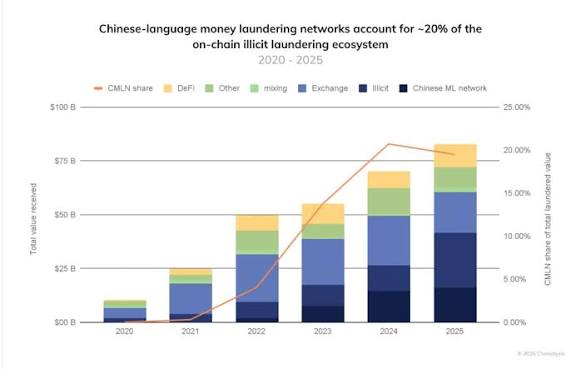
Chinese-language laundering networks now account for roughly 20% of known illicit crypto activity, according to Chainalysis. The broader on-chain money laundering ecosystem has expanded from $10 billion in 2020 to over $82 billion in 2025, driven by growing crypto accessibility and changes in laundering methods.

Chainalysis data shows these networks, often operating via Telegram, consistently launder more than 10% of funds stolen through “pig butchering” scams. Use of centralized exchanges has declined, while inflows to Chinese-language networks have surged far faster than other endpoints—over 7,000 times faster than exchanges, nearly 2,000 times faster than DeFi, and more than 2,000 times faster than intra-illicit transfers.

The ecosystem now includes six distinct service types that collectively processed $16.1 billion in 2025, with active wallets increasing to 1,799. Transaction patterns mimic traditional money laundering methods, including smurfing and aggregation.

Other networks are also evolving. In December 2024, UK authorities dismantled a multi-billion-dollar Russian-language laundering network serving cybercriminals, drug gangs, and elites. Experts note that limited enforcement capabilities make crypto a low-risk, high-reward tool for criminals worldwide.

Super Wednesday: Could Fed and Oil Data Spark Big Bitcoin Moves?

Bitcoin faces potential volatility on January 28, 2026, as the Federal Reserve’s interest rate decision and U.S. crude oil inventory data converge. Both events could influence inflation and liquidity expectations, impacting risk assets including Bitcoin.

On-chain analyst GugaOnChain called the day a “super Wednesday,” noting that Bitcoin is sensitive to energy shocks and monetary policy shifts. West Texas Intermediate crude futures for March were around $61 per barrel, down 0.7%, while open interest dropped by over 21,000 contracts, suggesting traders are reducing exposure ahead of key data.

Bitcoin showed a slight negative correlation with oil over the past week, rising just over 5% while crude remained flat. According to the analyst, energy markets serve as a barometer for inflation expectations, which in turn affect liquidity and crypto prices.

At the time of reporting, Bitcoin traded in a narrow range between $87,000 and $89,000, up 0.6% in 24 hours but down about 3.6% for the week. Year-over-year, BTC is roughly 12% lower and nearly 30% below its October all-time high above $126,000.

Institutional flows remain uneven, with $405 million exiting Bitcoin investment products in one week as expectations for near-term Fed cuts faded. Analysts note that both crypto and traditional markets are in “wait-and-see” mode, absorbing policy signals rather than chasing short-term gains.

Crypto Traders Flock to Silver Before 15% Crash

Silver experienced one of its most dramatic single-day swings in years on Monday, climbing above $117 before crashing more than 15% in hours, wiping out roughly $900 billion in market value in 90 minutes, according to The Kobeissi Letter.

Santiment data shows retail attention, including crypto traders, shifted from gold to silver as prices surged, often coinciding with short-term tops. Silver briefly touched $118 before falling to around $103, then partially rebounding toward $110.

The volatility highlighted the speed of speculative flows, with the $900 billion drop representing about 72% of the entire altcoin market cap. Analyst Checkmate noted heavy retail activity, with buyers lining up for physical silver, though the process was slower and less flexible than trading BTC.

The move came while Bitcoin traded near $88,000, remaining range-bound between $87,000 and $89,000. Analysts interpret the silver rally as part of a broader risk-off mood, with investors favoring established stores of value like silver and gold over crypto.

The episode illustrates how quickly retail sentiment can swing and how volatile these inflows can be, even for traditional assets.

Bitcoin Hashrate Plummets as Texas Miners Shut Down Due to Ice Storm

A severe winter storm in Texas is forcing Bitcoin miners offline, causing the network hashrate to drop sharply. Bitcoin’s computing power fell from 1.133 ZH/s to 690 EH/s in just two days, according to CryptoQuant analyst Darkfost. Blockchain.com reports a 7-day moving average of 950 EH/s, reflecting a lagging view.

The storm is disrupting the power grid and driving up electricity costs, prompting major Texas miners like MARA and Foundry Digital to shut down rigs. This has slowed block times and is expected to trigger a 4.5% reduction in mining difficulty. Emergency measures by the US Department of Energy are helping the grid, but analysts warn miners could be forced to sell BTC to cover expenses while waiting for conditions to improve.

Network hashprice is also at a low $0.039 per TH/s per day, making profitability difficult. Bitcoin briefly reached $88,500 on Tuesday but remains down 4.5% for the week, trading within the lower bounds of a three-month sideways range as bearish sentiment persists.

Warning Sign for Crypto: Stablecoins See Historic $7B Weekly Dip

Stablecoin supply on Ethereum fell by around $7 billion last week, dropping from $162 billion to $155 billion, according to on-chain data from analyst Darkfost. This is the first sharp weekly contraction in ERC-20 stablecoins of the current market cycle, signaling thinning liquidity as prices correct and capital moves elsewhere.

Darkfost noted that a declining stablecoin market cap often reflects investors converting digital dollars back into fiat, which leads issuers to burn excess supply. Similar patterns appeared in 2021 during Bitcoin’s prolonged downturn.

Exchange flows reinforce the trend. Binance recorded its largest weekly outflows since November 2025, with over $6 billion leaving across BTC, ETH, and ERC-20 USDT. Meanwhile, USDT on Tron saw an inflow of $905 million, suggesting some network shifts rather than total exits.

The outflows coincide with Bitcoin slipping below $88,000, extending its weekly losses past 5%, and indicate heightened volatility rather than a clear market direction.

Liquidity pressure is compounded by macro factors. Binance’s USDT reserves fell from $9.16 billion to $4.6 billion in under two weeks, and U.S. Federal Reserve net liquidity declined by roughly $90 billion, historically weighing on risk assets.

While long-term expectations for stablecoins remain optimistic, recent on-chain data shows traders are reducing exposure, leaving crypto markets with less immediate liquidity support..

Vitalik Buterin Revises 2017 View on Full Blockchain Validation

Ethereum co-founder Vitalik Buterin has said he no longer agrees with his 2017 view that average users validating the full blockchain is unrealistic. He explained the shift in a social media post on January 26, 2026, citing advances in cryptography and renewed emphasis on user sovereignty.

Full Validation Now Feasible

In 2017, Buterin described requiring users to re-execute the entire blockchain history as impractical, leaving them reliant on third-party providers. He now believes zero-knowledge proofs, particularly ZK-SNARKs, allow users to confirm the chain’s correctness without replaying all transactions. This reduces computational load while maintaining independent verification.

He also framed the change around practical risks, including network outages, high latency, service shutdowns, concentration of validators, and censorship. Relying solely on external providers creates single points of failure, undermining self-custody. Buterin revived his “Mountain Man’s cabin” metaphor, suggesting full validation does not need to be daily practice but can serve as a fallback when intermediaries fail, incentivizing fairer services.

Link to Ethereum’s Long-Term Vision

Buterin’s updated stance aligns with his recent focus on simplicity and self-sovereignty. He has warned that Ethereum’s growing complexity could threaten trustlessness, promoted privacy tools to reclaim digital autonomy, and advocated increasing network bandwidth over lowering latency to scale without compromising decentralization.

Overall, Buterin’s reversal indicates a philosophical shift: independence and convenience no longer have to be mutually exclusive, and modern cryptography can make personal verification practical again, even if primarily as a safeguard.

Bitcoin Not in Bull Phase as Analysts Warn Lower Levels May Still Come

Bitcoin investors are facing growing pressure and uncertainty as the market downturn deepens, with some experts saying the recent lows may not mark the end of the decline.

Crypto markets started the week on the back foot, with Bitcoin briefly sliding toward $86,000 as risk off sentiment spread across the sector. The price later recovered slightly and is trading near $87,800, though analysts remain cautious.

Analysts See Ongoing Bear Market

Well known analyst Mr. Wall Street said Bitcoin is not in a bull market and that expectations of a quick rebound are premature. He argued that the drop to levels last seen in mid December 2025 did not establish a lasting bottom and described current conditions as part of a large scale bear market.

According to him, further downside is likely, with much lower price targets ahead rather than a rapid recovery.

Analyst Axel Adler Jr. shared a similar view, saying the current environment is difficult for holders and marked by pressure, exhaustion, and doubt. He believes the crypto winter began in November and is continuing to intensify. Adler added that such periods tend to separate disciplined participants from late cycle speculators, ultimately resetting the market.

Defensive Positioning Takes Hold

The broader selloff has been fueled by rising stress in currency markets after a New York Fed signal suggested concern over a weaker yen, with 160 seen as a warning level for USD/JPY. Although the pair remains near 154, investors have started unwinding short yen positions to avoid potential intervention.

Political uncertainty in the United States is also weighing on sentiment. With government funding set to expire on January 30, tensions between House Republicans and Senate Democrats have raised the risk of a partial shutdown. Polymarket currently assigns a high probability to that outcome.

In crypto markets, defensive positioning is growing. Options data shows rising implied volatility and stronger demand for downside protection, with analysts expecting choppy price action until clearer signals emerge.

XRP and ADA Appear More Undervalued Than Bitcoin, Data Suggests

Ripple and Cardano are showing deeper signs of undervaluation than Bitcoin, according to new on chain metrics from Santiment.

Bitcoin faced strong selling pressure over the weekend as macro conditions worsened. After the pullback, several cryptocurrencies have slipped back into undervalued territory, with XRP and ADA standing out among major assets.

XRP Shows Stronger Value Signal Than BTC

Santiment’s 30 day Market Value to Realized Value ratio is often used to assess risk when entering or adding to a position. Lower or negative readings suggest reduced downside risk, as the average trader is holding at a loss. The more negative the figure, the more attractive the potential entry point.

In contrast, a positive MVRV indicates that most traders are in profit, which raises the risk of buying at elevated levels. Higher positive values are considered increasingly risky.

In its latest data, Santiment placed XRP at a 30 day MVRV of minus 5.7 percent, marking it as undervalued and more discounted than Bitcoin, which registered minus 3.7 percent and was labeled only mildly undervalued.

Other major altcoins also appeared undervalued. Chainlink recorded the lowest MVRV at minus 9.5 percent, followed by Cardano at minus 7.9 percent and Ethereum at minus 7.6 percent.

XRP Enters Reaccumulation Phase

XRP has fallen nearly 4 percent over the past week after slipping below the $2 level. The token briefly tested support near $1.81 before rebounding to around $1.89 on Monday. Despite recent weakness, some analysts believe the broader structure remains bullish.

Crypto analyst ChartNerd highlighted a long term technical setup, noting that after a strong breakout in December 2024, XRP has spent the past year retesting a former seven year resistance trendline. The analyst described this period as a reaccumulation phase, similar to the structure seen in 2017 before a major rally. According to ChartNerd, holding this retest could support further upside.