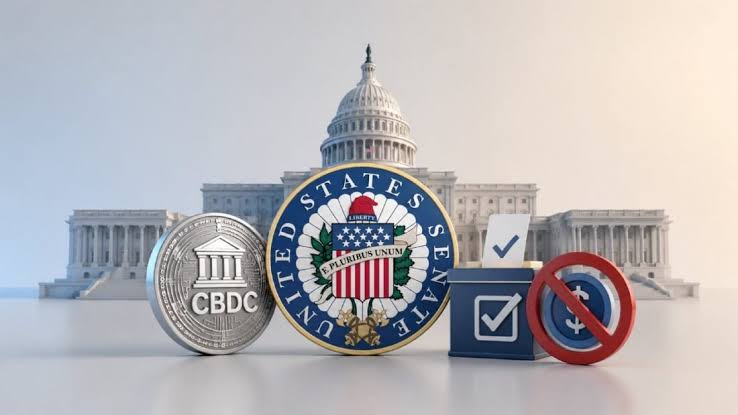
The United States Senate has approved a major bipartisan housing bill that includes a provision preventing the Federal Reserve from issuing a US central bank digital currency until 2030.
The bill passed with strong bipartisan support in an 85 to 5 vote and now moves to the House, where lawmakers are expected to push it forward quickly.
CBDC Restriction Included in Housing Legislation
The housing bill is primarily focused on improving housing affordability and reducing market pressure from large corporate buyers. However, one of its most notable provisions places a temporary block on the Federal Reserve’s ability to launch a US central bank digital currency.
The anti CBDC clause has become one of the most significant crypto related policy developments in recent months.
This measure follows months of legislative negotiations. The Senate first added the CBDC restriction in March, and the House later approved the amended version in May.
Donald Trump had already signed an executive order in January 2025 preventing his administration from pursuing a CBDC, citing concerns over financial stability and personal privacy. However, because executive orders only apply during a president’s term, congressional allies pushed to formalize the restriction through legislation.
House Financial Services Committee Chairman French Hill said he expects the House to move swiftly to send the bill to President Trump’s desk.
Tim Scott described the bill as a major step toward delivering meaningful relief to Americans, while Elizabeth Warren called it the most significant housing legislation in more than three decades.
Focus Shifts to Crypto Regulation
Attention is also turning toward the upcoming debate around the CLARITY Act, another major piece of legislation tied to digital asset regulation.
The House Financial Services Committee has scheduled a hearing in New York on July 17 to examine how the bill could shape financial innovation and the broader digital asset sector.
Cynthia Lummis has remained one of the strongest advocates for clearer crypto regulation. She has repeatedly argued that regulatory uncertainty is pushing blockchain developers and innovation outside the United States.
Regulatory Pressure Continues
The push for clearer rules comes as legal pressure on parts of the crypto industry continues to grow.
One high profile case involves Roman Storm, a developer associated with Tornado Cash. He was found guilty of knowingly transmitting more than $1 billion in criminal proceeds.
The United States Department of Justice is also seeking a retrial after the jury failed to reach a verdict on separate money laundering and sanctions related charges.
The latest developments highlight how crypto policy in the United States is increasingly being shaped through both legislation and courtroom battles.#crypto#cryptonews https://coinsignals.net https://t.me/coinsignalpublic