coinsignals

RIVER Jumps 40% as Bitcoin Rebounds From Five Week Low

MYX, meanwhile, has fallen roughly 15 percent on the day.

Fresh tariff threats over the weekend, combined with growing concerns about a potential US government shutdown, pushed Bitcoin lower, sending it to a five week low near $86,000.

Most altcoins are trading in the red again today, with RIVER standing out as the clear exception, continuing to move independently of the broader market.

Bitcoin Drops Then Stabilizes

Bitcoin’s latest correction began a week ago when the price fell sharply from above $95,500 to $92,000 within hours of traditional markets opening. Selling pressure intensified in the following days, dragging BTC down to $87,000 by Wednesday.

A brief relief rally followed after former President Trump stated he would not use force to take control of Greenland. This sparked volatility that lifted BTC close to $91,000 before it slipped back below $90,000. Despite this bounce, sellers remained in control, and Bitcoin spent much of the quiet weekend hovering around $89,000.

On Saturday, Trump warned of imposing 100 percent tariffs on Canada if it enters a comprehensive trade agreement with China. At the same time, reports surfaced suggesting the US government could shut down amid unrest in several states.

These developments triggered another sharp drop, sending Bitcoin to its lowest level since December 19 at around $86,000 on Sunday evening. The price has since recovered modestly and is now trading near $88,000. Bitcoin’s market capitalization has declined to about $1.75 trillion, while its dominance remains steady at 57.5 percent.

RIVER Defies the Broader Market

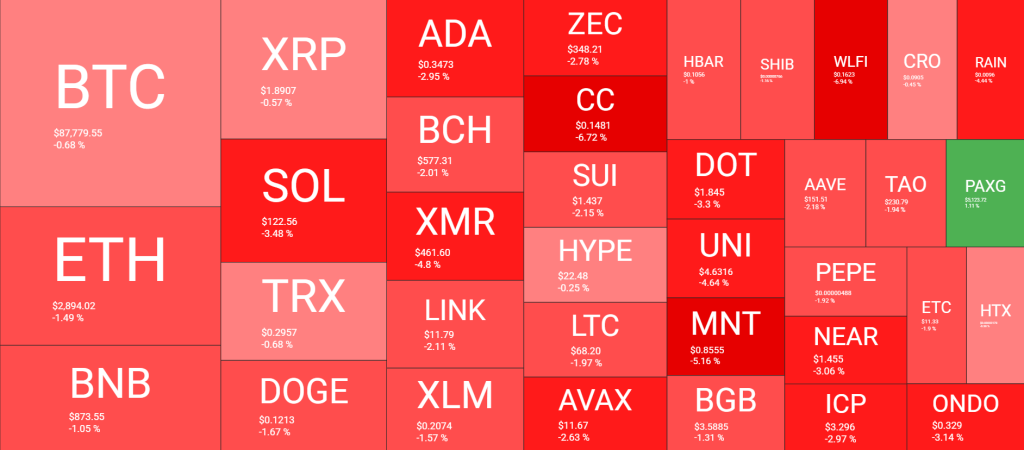
Altcoins continue to struggle across the board. Ethereum has fallen below $3,000 and is now trading under $2,900. BNB has slipped beneath $875, while XRP is below $1.90. Solana, Cardano, and Monero have posted some of the steepest losses among large cap assets. CC is down nearly 7 percent on the day, followed by a 5 percent decline in MNT.

In sharp contrast, RIVER continues its impressive run. The token has surged 40 percent in the past day, gained 230 percent over the week, and is up an astonishing 2,100 percent over the past month. It is currently trading around $84, giving it a market capitalization exceeding $1.6 billion.

Despite RIVER’s rally, the total cryptocurrency market capitalization has fallen to approximately $3.05 trillion, shedding another $30 billion over the past 24 hours.


Bitcoin Slips Under $88K as Two Overlooked Warning Signals Emerge

Bitcoin dropped below $88,000 after daily transaction fees on Solana jumped to $37.5 million, a pattern that has appeared ahead of previous Bitcoin pullbacks.

Bitcoin fell under the $88,000 level on January 25, 2026, following a surge in Solana network fees and renewed whale activity on Binance.

The decline has attracted attention because similar spikes in Solana fees have preceded past Bitcoin corrections. This has revived discussion around whether intense activity on one blockchain can serve as an early indicator of wider market stress.

Solana Fee Surge and Whale Movements Preceded the Decline

On chain data from January 24 and 25 highlighted two developments that aligned with Bitcoin’s slide from near $90,000. First, large investors transferred roughly 2,000 BTC to Binance on January 21. According to analyst Taha, such exchange inflows have historically been linked to distribution phases or positioning ahead of selling, though they do not always result in immediate price drops.

The second and more significant factor was a sharp rise in Solana transaction fees, which reached approximately $37.5 million on January 24.

This event closely mirrors activity seen on October 10, 2025, when Solana fees climbed to about $37 million while Bitcoin was trading near $114,000. In the weeks that followed, Bitcoin declined by roughly 27 percent.

Taha explained that these fee surges usually reflect peak network usage, often driven by automated trading systems and heavy leverage in decentralized finance. Such conditions can point to an overheated market.

Although rising fees can appear bullish, Solana’s fee patterns have frequently signaled upcoming Bitcoin corrections in the past, the analyst noted.

Market Reaction Shows Orderly Selling and Leverage Cleanup

At the time of writing, Bitcoin was trading just below $88,000 after briefly falling to around $86,000 in the previous 24 hours. The asset is down more than 5 percent over the past week and close to 17 percent on a yearly basis.

The move lower also weighed on altcoins. Tokens such as Sui, Arbitrum, Cardano, and Ethena posted losses, while Ethereum slipped below $2,900. Solana declined by more than 2.5 percent at one point, signaling a broader reduction in risk appetite across major cryptocurrencies.

Additional macro insight came from XWIN Research Japan. Analysts there pointed to growing political uncertainty in the United States, including an increased risk of a government shutdown ahead of the January 30 funding deadline, combined with a low liquidity environment.

They reported that roughly $170 million in long positions were liquidated within an hour, driven primarily by derivatives markets rather than spot selling. Open interest, estimated at about $28.4 billion, remains well below late 2025 peaks, suggesting leverage had already been reduced before the latest decline.

Overall, the data suggests the market is responding to concentrated activity and the unwinding of leverage. Once again, a spike in Solana fees has appeared alongside a Bitcoin pullback, not as a direct cause.

Four Factors That Could Move Crypto Markets in a Volatile Week Ahead

The week has started with high market volatility, and more turbulence is expected over the next five trading days. Markets are reacting to tariff threats from US President Trump, the possibility of a US government shutdown, and ongoing geopolitical tensions.

The Federal Reserve meeting and rate decision, along with new inflation data, are likely to add to the market swings. The Kobeissi Letter warned of significant volatility this week.

Key Events from January 26 to 30

Over the weekend, Trump threatened 100% tariffs on Canada if it proceeded with a deal with China, but Canadian Prime Minister Mark Carney said Canada has no plans for such an agreement, easing some investor concerns.

There is growing concern that the US government could face a partial shutdown as Senate Democrats oppose a funding package. Government funding expires at the end of the week, with Republicans pushing to avoid another shutdown, according to sources cited by CNBC.

Economic releases include the US Consumer Confidence report on Tuesday, the Fed interest rate decision on Wednesday, and December’s Producer Price Index (PPI) data on Friday, which tracks changes in prices received by domestic producers for goods and services.

Corporate earnings will also influence markets, with four of the “Magnificent 7” reporting this week. Microsoft, Meta, and Tesla report on Wednesday, while Apple reports on Thursday. Stock futures were already declining on Monday, hinting at a turbulent week ahead.

Crypto Market Outlook

Crypto markets opened the week deep in the red. Total market capitalization dropped 1.8% to $3 trillion on Monday morning.

Bitcoin led the decline, falling to $86,000, its lowest in five weeks, before slightly rebounding to $87,700. The asset is approaching key support levels that, if broken, could signal a broader bear market.

Ether also weakened, dipping below $2,800 with minimal recovery. Most altcoins followed suit, resulting in widespread losses across the market.

Bitcoin Slides Below $88,000 as Liquidations Spike

Bitcoin’s price has sharply declined below $88,000, triggering a surge in liquidations that erased more than $130 million in leveraged positions within just one hour.

Following a calm weekend where neither buyers nor sellers took control, BTC resumed its downward move, reaching a new multi day low well under $88,000. Altcoins followed the same trend, with Ethereum falling below $2,900 and Solana dropping more than 2.5 percent in a single hour.

According to analysts at the Kobeissi Letter, the correction is likely driven by macro uncertainty. Key factors include fears of a potential US government shutdown following the Minneapolis shooting and renewed tariff threats from President Trump toward Canada. As previously reported, Trump warned of a possible 100 percent tariff if Canada proceeds with a major agreement with China.

Similar to last weekend, Bitcoin initially held steady but began to weaken as futures markets approached their opening. After failing to break above $89,000 earlier in the day, BTC fell to a five day low near $87,500.

The past hour has been especially brutal for altcoins. Tokens such as SUI, SOL, ARB, PEPE, ENA, and ADA dropped by more than 2 percent. Ethereum alone lost 1.5 percent in the last hour and remains stuck well below $2,900.

Total liquidations over the past 24 hours reached $250 million, with more than half occurring in the most recent hour. Data from CoinGlass shows $131 million in positions were wiped out during that period. Over 130,000 traders were liquidated in a single day, with the largest individual position worth $6.3 million on Hyperliquid.

Bitcoin Headed to a $16 Trillion Valuation? ARK Predicts BTC Could Dominate 70% of the Crypto Market

ARK Invest believes that by 2030, only two or three Layer 1 blockchain platforms will capture the majority of value in the smart contract sector.

In its Big Ideas 2026 report, ARK Invest estimated that smart contract networks and pure digital currencies could reach a combined market value of $28 trillion by 2030. According to the firm, these assets function as stores of value, mediums of exchange, and units of account on public blockchains and could grow at an annual rate of roughly 61 percent through the end of the decade.

ARK projects that Bitcoin alone could represent about 70 percent of the total crypto market, with the remaining share largely led by smart contract platforms such as Ethereum and Solana.

Bitcoin at the Center of ARK’s 2030 Forecast

Under ARK’s outlook, Bitcoin’s market capitalization could grow at a compound annual rate of approximately 63 percent, rising from nearly $2 trillion today to around $16 trillion by 2030.

The firm also expects the market value of smart contract platforms to increase at a 54 percent annual rate, reaching about $6 trillion by 2030. This growth would be supported by estimated annual revenues of $192 billion, assuming an average take rate of 0.75 percent. ARK noted that just two to three Layer 1 networks are likely to command most of this market.

ARK further reported that US Bitcoin ETFs and publicly traded companies held 12 percent of the total Bitcoin supply in 2025, up from 8.7 percent previously. ETF holdings alone rose nearly 20 percent during the year, increasing from about 1.12 million BTC to nearly 1.3 million BTC.

Public companies also significantly expanded their Bitcoin reserves, with holdings climbing 73 percent from roughly 598,000 BTC to about 1.09 million BTC.

The firm observed that Bitcoin delivered stronger risk adjusted returns than most major cryptocurrencies and traditional indexes for much of 2025. Its average annual Sharpe Ratio exceeded those of Ethereum, Solana, and the average of the remaining assets in the CoinDesk 10 Index since the market cycle low in November 2022, as well as since the start of 2024 and 2025.

ARK added that Bitcoin’s volatility has continued to decline as it increasingly takes on a safe haven role.

A Future with Only a Few Lasting Digital Assets

ARK also found that Layer 1 networks are transitioning from purely revenue driven platforms into monetary assets. Using a high growth revenue multiple of 50 times Ethereum’s network revenue, the firm estimated that more than 90 percent of Ethereum’s market value is tied to its monetary role. In contrast, Solana generated $1.4 billion in revenue, meaning roughly.

Bitcoin Holders Begin Realizing Losses as Profit Trends Turn Negative, Says CryptoQuant

For the first time in over two years, Bitcoin holders are facing losses on their investments. Analysts suggest this shift could indicate that BTC and the wider crypto market are approaching a bear cycle.

A weekly report from CryptoQuant notes that network participants have not experienced such a negative turn in profit trends since October 2023. Over the past 30 days, realized net profits have turned into losses.

The report highlights that since December 23, Bitcoin holders have realized losses totaling approximately 69,000 BTC. Realized profits have been declining since March 2024, coinciding with the slowdown at the end of the recent bull phase. Analysts see parallels with the 2021-2022 bull cycle, when net profits peaked in January 2021 and gradually declined over the year, eventually turning negative despite higher prices.

A similar pattern emerged in 2024, with realized profits reaching a peak in January and then forming lower peaks in December 2024, July 2025, and October 2025. Now, Bitcoin holders are seeing net losses, marking a negative shift in profit dynamics.

Most on-chain metrics suggest that the market is entering the early stages of a bear cycle. While recent reports noted slight improvements in Bitcoin demand, these changes have not been significant. Demand from exchange-traded funds and spot markets has remained largely unchanged, with overall activity contracting over the past month.

$47 Million in Bitcoin Disappears From South Korean Prosecutors’ Custody in a Shocking Mishap

Authorities in South Korea are investigating after Bitcoin seized in a criminal case was found missing from government custody. While the exact amount has not been officially confirmed, local media report that around $47.7 million worth of BTC may have been lost, possibly after an agency employee fell victim to a phishing scam.

The disappearance came to light during a routine internal review of confiscated assets, which includes verifying passwords and access information stored on devices such as USB drives. Officials suggested the loss might have occurred when an employee accidentally visited a fraudulent website, potentially exposing wallet credentials to attackers who then drained the seized funds.

Authorities are currently examining the situation and attempting to trace the missing Bitcoin, but details remain limited.

Phishing attacks continue to pose a significant threat to both individual and institutional crypto holders. Earlier this year, users of the Ledger hardware wallet were targeted following a data breach at a partner company. Scammers sent emails directing victims to fake websites to steal recovery phrases.

Similarly, Bitget CEO Gracy Chen warned in December about rising phishing scams using fake Zoom and Microsoft Teams links. Scammers exploit fake connection issues to trick users into downloading malware or revealing sensitive crypto information. Users are advised to verify all meeting links, avoid installing software during calls, and report suspicious contacts immediately.

GoMining Survey Finds 55% of Bitcoin Holders Rarely Use It for Everyday Payments

A recent survey by crypto mining platform GoMining reveals that more than half of Bitcoin holders do not use their coins for real-world transactions. Over 5,700 respondents shared their experiences, highlighting challenges that prevent crypto from becoming a common payment method.

The survey showed that 55 percent of participants rarely or never use Bitcoin for daily purchases, even though many believe in crypto adoption and value its privacy features. Respondents cited several reasons behind their reluctance.

Lack of Infrastructure

The main obstacle is the limited infrastructure for accepting crypto payments. Nearly 49 percent of participants said most merchants do not accept Bitcoin. GoMining CEO Mark Zalan noted that people are unlikely to develop a habit of using crypto if they have to search extensively for places that accept it.

Other barriers include high fees, cited by 44.7 percent of respondents, and slow transaction processing, noted by 26.8 percent. Proof-of-work networks like Bitcoin often struggle with speed and cost, making traditional payment methods more convenient for everyday use.

Volatility and Scams

Price volatility also discourages crypto use, with 43 percent of respondents citing this as a reason to avoid daily payments. Many users prefer stablecoins for transactions because they provide predictable value and faster settlement. Zalan highlighted that systems combining stablecoins with card-style interfaces can reduce friction for merchants and make payments feel familiar to consumers.

Security concerns also play a role, as 36.2 percent of respondents said the risk of scams prevents them from using crypto for routine purchases.

When asked whether Bitcoin should be pushed as a payment method, Zalan expressed caution. He said that Bitcoin can function as a settlement or reserve layer for faster payment systems above it, but other tokens may be better suited for governance, network utility, or specialized use cases rather than as money.

a16z Outlines 11 Ways Crypto Could Intersect With Artificial Intelligence

Andreessen Horowitz’s crypto team recently highlighted 11 areas where blockchain technology could converge with artificial intelligence, explaining how crypto tools may influence identity, payments, and ownership as AI becomes more embedded across the internet.

Rather than treating crypto as a speculative asset, the firm presented it as core infrastructure that could help counter the increasing centralization of AI by giving users greater control over their data, digital identities, and economic participation.

In a January 20 post on X, a16z crypto said the web is shifting toward AI driven interfaces, which raises concerns about who owns data, controls distribution, and captures revenue as traditional websites lose traffic. The firm argued that blockchains can act as a neutral foundation for AI systems by enabling persistent user context, portable identities for AI agents, and open payment rails that do not depend on platform intermediaries.

Several of the proposed ideas focused on identity and trust. One example was decentralized proof of personhood, which aims to help platforms tell humans and bots apart without relying on centralized identity providers. The firm referenced existing initiatives such as World’s Proof of Human, along with newer tools like the Solana Attestation Service, which allows users to connect off chain credentials to wallets while preserving privacy.

Payments also featured prominently. a16z described how blockchains could enable micropayments between AI agents, content creators, and users. This could include revenue sharing when AI systems depend on third party content, as well as models where web crawlers directly compensate websites for access to their data.

The firm noted that almost half of all internet traffic now comes from automated sources, while more site operators are blocking AI scrapers. This growing tension has already led companies like Cloudflare to offer paid blocking services.

The post also pointed to decentralized physical infrastructure networks, known as DePIN, as a potential way to supply AI with compute and energy resources. By pooling unused hardware from gaming PCs and data centers, these networks aim to reduce dependence on large cloud providers.

Many of these themes reflect broader discussions within the crypto space. Ethereum co founder Vitalik Buterin has recently said he plans to move away from centralized social platforms in favor of decentralized alternatives, arguing that shared data layers encourage competition without trapping users in a single interface. The Ethereum Foundation has taken similar steps, launching an AI focused team last year to explore agent based payments and coordination, with the goal of positioning Ethereum as a settlement layer for AI and machine to machine transactions.

a16z acknowledged that most of these ideas are still far from mass adoption. Concepts such as user owned AI companions or fully open markets between autonomous agents remain long term visions. Even so, the firm’s framework offers a glimpse into how investors and builders see crypto fitting into a future where AI systems act as constant intermediaries between people, data, and money.

Bitcoin Faces Renewed Pressure as Trump Threatens Canada With Massive Tariffs Over China Deal

Bitcoin is once again drawing attention after Donald Trump warned that Canada could face heavy trade penalties. He said the United States would impose a 100 percent tariff on all Canadian imports if Canada moves ahead with a trade agreement with China.

Relations between the two countries have become more strained following Trump’s statement on social media, where he made clear that he is willing to take aggressive trade action against America’s northern neighbor. The warning comes as reports suggest Canada is exploring deeper economic ties with China.

Because Bitcoin has previously reacted strongly to trade disputes and tariff threats, investors are closely watching price movements over the next two days to see how the market responds.

Trump posted on Truth Social that Canada could face the full tariff if Prime Minister Mark Carney agrees to allow the country to act as a gateway for Chinese goods entering the US. He claimed such a move would severely harm Canada’s economy and warned that China would overwhelm Canadian businesses, disrupt society, and damage the country’s overall way of life.

News of a possible strategic trade partnership between Canada and China surfaced about a week ago. Early details indicate the agreement would focus on lowering trade barriers and could include Canada importing nearly 50,000 electric vehicles from China at reduced tariff rates.

Before issuing this latest warning, Trump had already withdrawn an invitation for Canada to join his Board of Peace initiative. During a speech in Davos, he also stated that Canada’s economic stability depends on the United States.

Bitcoin has shown sensitivity to tariff related news in the past, even when no action has been taken. Just last week, after Trump announced new tariffs targeting several European countries, Bitcoin fell sharply from above 95,000 dollars to around 87,000 dollars within a few days.

Following Trump’s latest comments, Bitcoin briefly dropped by about 500 dollars. While the move was relatively small, traders expect higher volatility once global financial markets reopen on Monday.